Wednesday, March 7, 2012

The Great Gatsby and Music

I believe the song With You by Josh Groban does an excellent job of portraying the longing, regret, and hope that Gatsby has about Daisy. There are several aspects of the song that reflect this, including the lyrics and the “mood” of the song.

It is fairly easy to connect the lyrics to Gatsby’s feelings towards Daisy in the early part of the book. He has been waiting for five years to be with her, watching the green light on her dock and hoping. He regrets they aren’t together and longs to meet with her, but he’s scared to. The lyrics “I was scared to share the love I have inside of me,” reflects Gatsby’s fear of contacting Daisy to share his love with her. The chorus is also representative of Gatsby; it says that “I know that I was meant to be…with you,” reflecting his view that he and Daisy are meant to be together.

The “mood” of the song can also be linked to Gatsby’s feelings about Daisy before they meet again. It has a sad and regretful feel to it, and the way Groban sings it enhances this. While there is this constant undertone of sadness, there are also hints of hope in the chorus; the lyrics reflect this and I believe the song also switches from minor to major during the chorus to musically show this shift in emotion.

Sunday, March 4, 2012

A Compare/Contrast of the Iroquois and US Constitutions


There seem to be quite a few parallels between the constitution of the Iroquois nations and the constitution of the United States. One of the most obvious is the division power and authority between the different tribes in the league. There are two different groups, one made up of the Mohawk and Seneca and the other made up of the Oneida and Cayuga. Each of these groups must reach a consensus on an issue before it is passed on to the Onondaga, who resolve any differences in opinion and confirm the final decision. This is very similar to the way the different branches in the US government are set up and operate. Bills must pass through the two houses Congress and then receive approval from the President.

Another similarity is the ability of the Mohawk/Seneca and Oneida/Cayuga group’s ability to overturn a decision that the Onondaga makes that doesn’t fit with what they want. This is very similar to the power of Congress to override a president’s veto. If the other four tribes override the decision of the Onondaga, the Onondaga representatives are required to go along with the decision. This is mirrored exactly in the US constitution, which says that if Congress is able to override a veto, the president has to accept it.

A difference I noticed between the two constitutions is that the Iroquois’ seems to be much more focused on having agreement between the different groups. It says that the Onondaga Lords or their representatives must agree with the majority unless there is a good reason for them to disagree. This is, unfortunately, definitely not the case in the US government, as recent deadlocks have shown. While the US government was designed to move slowly and to have many checks, it also has to function effectively and get stuff done, and in this area I believe the Iroquois constitution does a much better job of accomplishing this. 

Thursday, February 23, 2012

Transcendentalism


While there are some elements of transcendentalism that I do agree with, I wouldn’t call myself a transcendentalist. I agree that self-reliance can be a good thing and that you can determine who and what you are by yourself, but I don’t agree that man is inherently good or that it is always best not to follow examples set by others or by history.


Being self-reliant is generally a good thing. If you can’t get by without constant support and can’t get along by yourself or come up with ideas on your own, you’re probably going to have problems in life. You have to have some degree of self-reliance to be able to find out who you are as a person and succeed in life. On the other hand, I don’t agree with the transcendentalist view that all people are inherently good. I’ve had enough personal experiences and know enough about history and current events to realize that this isn’t true. If people were inherently good, they wouldn’t have committed the atrocities that we know they have.


I also don’t believe that it is always best to ignore the precedents and examples set by others and by history. While going your own way and being original is a good thing, there is so much that can be learned and that can benefit you if you do learn from others and from history. When we were talking about this in class, I instantly thought of the quote, Those who cannot remember the past are condemned to repeat it.” I believe this to be true, and if someone were to ignore history and choose to go their own way like transcendentalists believe you should, there is always the possibility that what they come up with will cause a repeat of a terrible event in history.

Sunday, February 5, 2012

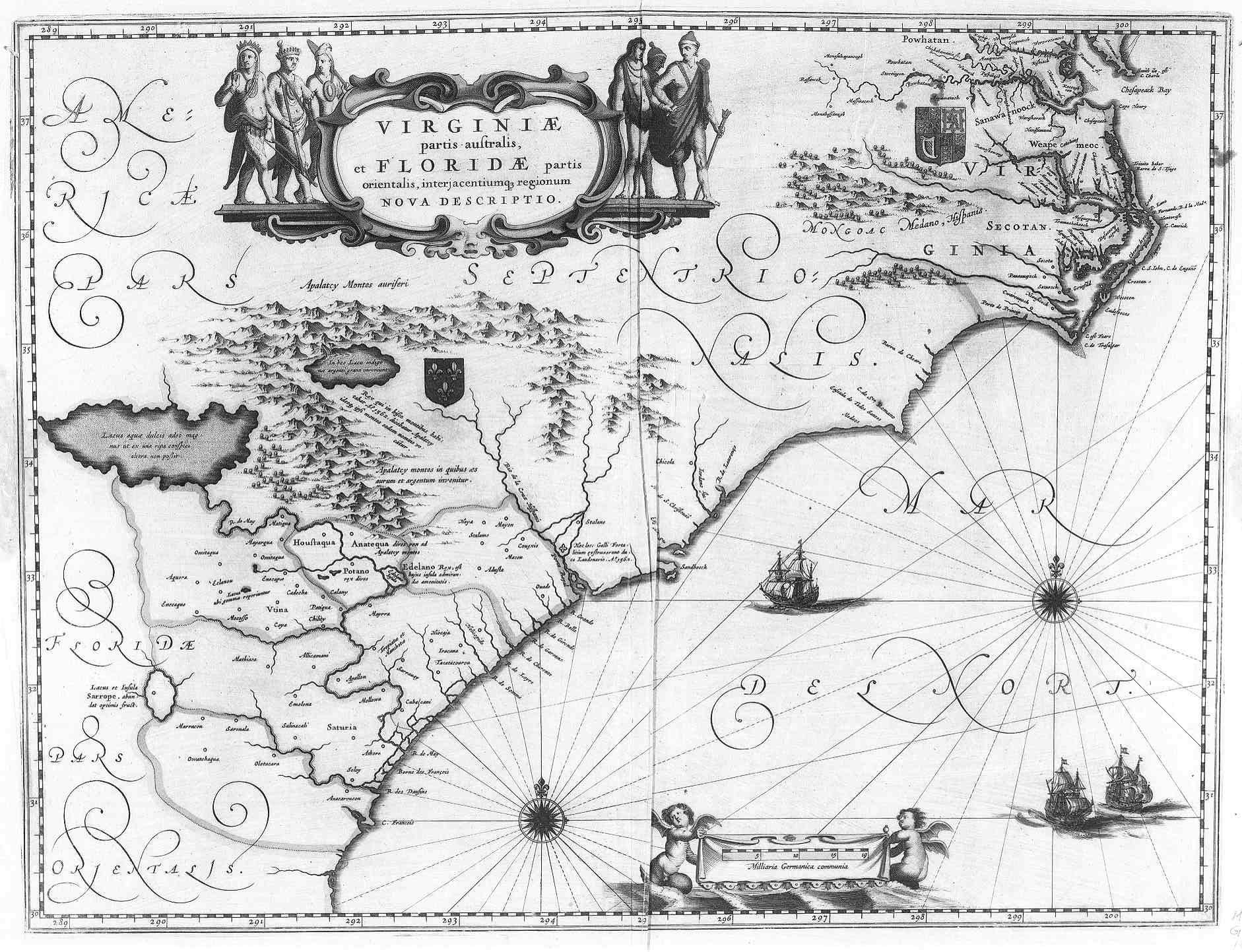
Map Analysis


This map of Virginia, Florida, Georgia, and the Carolinas is written in Latin. It seems to fairly accurate when compared to current maps. There are a fair amount of physical land features shown on this map. There are hills, mountains, rivers, forests, and lakes. The British and Spanish territories are marked by the countries respective coat of arms. The title of the map, which is located in the “western” side of the map, has drawings of the native people. These provide an idea of what they look like; the place on the map where they are located also shows where they predominantly now exist, west of European territories and settlements.

This map shows the increasing control and influence Europeans have over the Eastern coast of what will become the United States. There are still native names for some locations and the natives drawn on the map indicate that they are still there, but they are in the west. The eastern side of the map has predominantly European names and has signs of European control such as sailing ships. It also has angels on the east side of the map, possibly implying that the Europeans have God on their side. The natives are also dressed in a way that would be considered “primitive” by Europeans, which is part of the “characterization of Native Americans as uncivil, “savage,” “wild beasts...” This made it more acceptable for the Europeans to say that they should expand further west into native territory, to bring God and civilization to the “savage” natives.

Tuesday, November 1, 2011

Op-Ed Piece: America's Exploding Pipe Dream

http://www.nytimes.com/2011/10/29/opinion/blow-americas-exploding-pipe-dream.html?ref=columnists

I really liked this Op-Ed piece. It is blunt and straight to the point. It doesn’t dance around the issue at all. The author, Charles M. Blow, writes about how the United States is on a preventable decline that most people are just unwilling to step up and stop. He says we are allowing our country to lose its position of prominence in the world because we are making poor decisions and are still suffering under the delusion that we are the best country in the world, and that because of this we are not doing much if anything to uphold our position in the future.

He uses several rhetorical strategies in his essay. Logos, ethos, and pathos are all used to describe the poor shape our country is falling into. Logos is shown in the statistics comparing us to other countries, ethos is shown in the descriptions of how the rich unfairly and unethically hoard their wealth and buy off the government with it, and pathos is used with examples of the increasing poverty in the U.S. Blow also uses anaphora throughout the first half of his essay. Almost every sentence starts with “We…” emphasizing how everyone has played a part in letting this decline happen. He is also cynical at times, especially when talking about the rich and their part in this downward spiral.

Song for our Times

I believe an appropriate song for our times is “American Eulogy” by Green Day. I chose this song not only because I’m a huge Green Day fan, but because I feel it addresses many issues and problems in the United States today.

The first section of the song addresses political issues in the United States. The first verse makes references to the old, more inaccurate color-coded terror alert index and the “hysteria” and panic that it could cause. It also describes the confusion the alert index causes as being a “feeding ground” for the media and others who use the index to cause fear and anxiety by emphasizing when the threat level goes up. The second verse makes references to class differences and civil unrest. Unemployment is mentioned, as are riots and “class war” or conflict between the rich/Wall Street and the less well off. The third verse says that “America is falling,” representing that, while we are still a world power, we are gradually losing our power to other developing countries.

The first verse of the second section of the song is less about politics and more about feelings of unhappiness and dissatisfaction with the “modern (U.S.-centric) world” and the many problems it has. In this section the bassist and lead vocalist each sing from differing viewpoints about “the modern world” and are arguing back and forth with each other. This is shown when lead vocalist responds to and disagrees with the previous assertions about the “modern world” being a bad thing, saying to “deny the allegation” that it is and that everything bad that was said about it is “fuckin’ lies.” The bassist comes back with a counter-argument about the modern era being shallow, and how too much emphasis is put on being “up to date” and having fancy gadgets and “high definition,” and not on “the value of your mind,” or how smart or what kind of person you are.

Finally, the choruses of the two sections, “I don’t want to live in the modern world” and “mass hysteria” are blended together and static noise is added, creating a confusing section where there is conflict between the two opposing parts to be heard over the other.

My Fear

What do I fear? Well, I have a number of fears, but none more terrifying than death. Death is scary. For me its not necessarily the manner of dying, although some ways would certainly be preferable to others; it is the unknown after death. After you die, you’re gone. There is nothing left but your body, your shell. What makes you who you are, your personality, is gone forever and it’s not coming back.

I know that there are a lot of people who believe in some kind of life after death or reincarnation or something like that, and therefore don’t worry as much about this. I personally don’t believe in anything of that sort, and that is why the thought of death and being non-existent terrifies me. Just think about being alive and aware of who you are and how alive you are at one moment and then to suddenly ceasing to exist. It’s an incredibly frightening thought.