Wednesday, March 7, 2012

The Great Gatsby and Music

I believe the song With You by Josh Groban does an excellent job of portraying the longing, regret, and hope that Gatsby has about Daisy. There are several aspects of the song that reflect this, including the lyrics and the “mood” of the song.

It is fairly easy to connect the lyrics to Gatsby’s feelings towards Daisy in the early part of the book. He has been waiting for five years to be with her, watching the green light on her dock and hoping. He regrets they aren’t together and longs to meet with her, but he’s scared to. The lyrics “I was scared to share the love I have inside of me,” reflects Gatsby’s fear of contacting Daisy to share his love with her. The chorus is also representative of Gatsby; it says that “I know that I was meant to be…with you,” reflecting his view that he and Daisy are meant to be together.

The “mood” of the song can also be linked to Gatsby’s feelings about Daisy before they meet again. It has a sad and regretful feel to it, and the way Groban sings it enhances this. While there is this constant undertone of sadness, there are also hints of hope in the chorus; the lyrics reflect this and I believe the song also switches from minor to major during the chorus to musically show this shift in emotion.

Sunday, March 4, 2012

A Compare/Contrast of the Iroquois and US Constitutions


There seem to be quite a few parallels between the constitution of the Iroquois nations and the constitution of the United States. One of the most obvious is the division power and authority between the different tribes in the league. There are two different groups, one made up of the Mohawk and Seneca and the other made up of the Oneida and Cayuga. Each of these groups must reach a consensus on an issue before it is passed on to the Onondaga, who resolve any differences in opinion and confirm the final decision. This is very similar to the way the different branches in the US government are set up and operate. Bills must pass through the two houses Congress and then receive approval from the President.

Another similarity is the ability of the Mohawk/Seneca and Oneida/Cayuga group’s ability to overturn a decision that the Onondaga makes that doesn’t fit with what they want. This is very similar to the power of Congress to override a president’s veto. If the other four tribes override the decision of the Onondaga, the Onondaga representatives are required to go along with the decision. This is mirrored exactly in the US constitution, which says that if Congress is able to override a veto, the president has to accept it.

A difference I noticed between the two constitutions is that the Iroquois’ seems to be much more focused on having agreement between the different groups. It says that the Onondaga Lords or their representatives must agree with the majority unless there is a good reason for them to disagree. This is, unfortunately, definitely not the case in the US government, as recent deadlocks have shown. While the US government was designed to move slowly and to have many checks, it also has to function effectively and get stuff done, and in this area I believe the Iroquois constitution does a much better job of accomplishing this. 

Thursday, February 23, 2012

Transcendentalism


While there are some elements of transcendentalism that I do agree with, I wouldn’t call myself a transcendentalist. I agree that self-reliance can be a good thing and that you can determine who and what you are by yourself, but I don’t agree that man is inherently good or that it is always best not to follow examples set by others or by history.


Being self-reliant is generally a good thing. If you can’t get by without constant support and can’t get along by yourself or come up with ideas on your own, you’re probably going to have problems in life. You have to have some degree of self-reliance to be able to find out who you are as a person and succeed in life. On the other hand, I don’t agree with the transcendentalist view that all people are inherently good. I’ve had enough personal experiences and know enough about history and current events to realize that this isn’t true. If people were inherently good, they wouldn’t have committed the atrocities that we know they have.


I also don’t believe that it is always best to ignore the precedents and examples set by others and by history. While going your own way and being original is a good thing, there is so much that can be learned and that can benefit you if you do learn from others and from history. When we were talking about this in class, I instantly thought of the quote, Those who cannot remember the past are condemned to repeat it.” I believe this to be true, and if someone were to ignore history and choose to go their own way like transcendentalists believe you should, there is always the possibility that what they come up with will cause a repeat of a terrible event in history.

Sunday, February 5, 2012

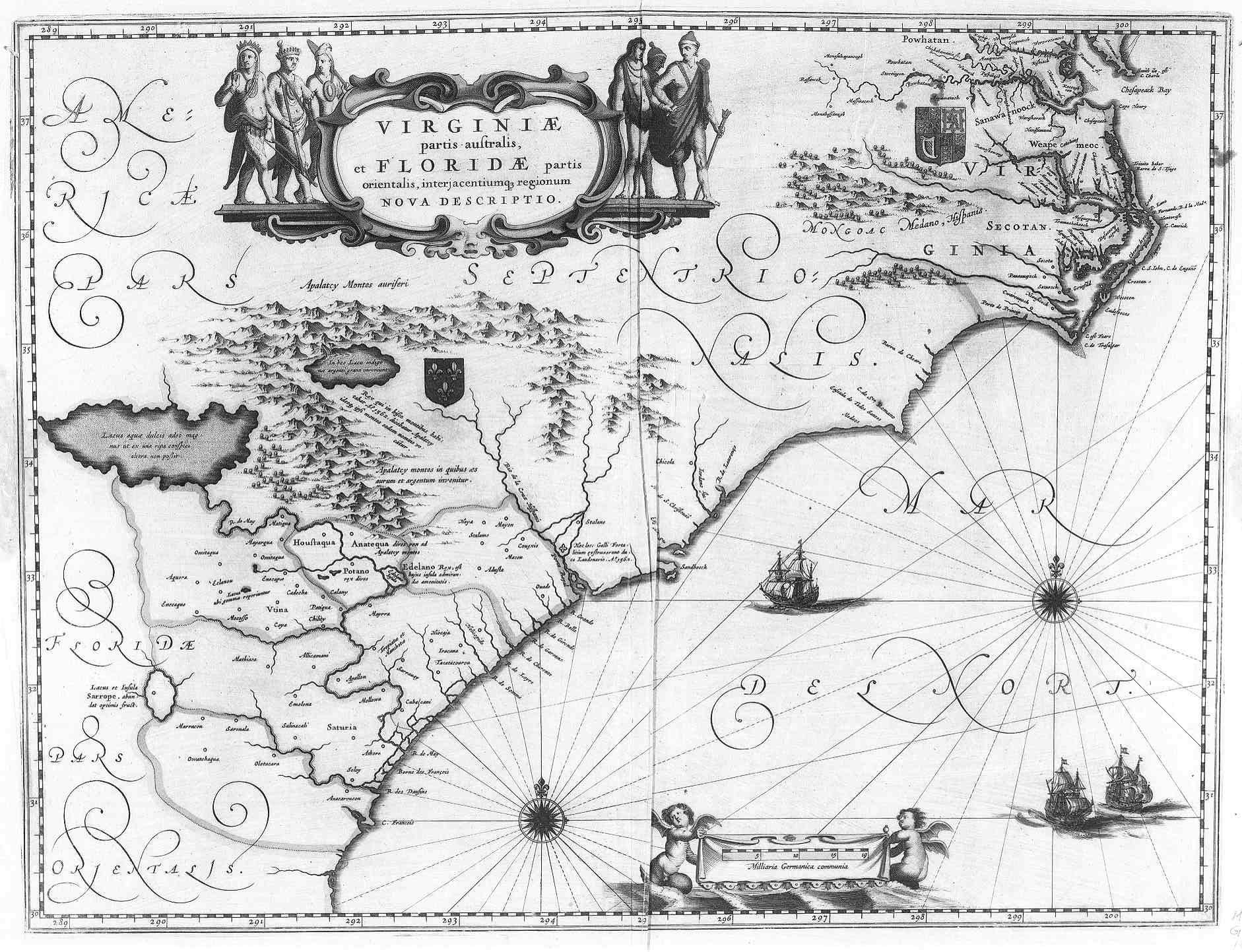
Map Analysis


This map of Virginia, Florida, Georgia, and the Carolinas is written in Latin. It seems to fairly accurate when compared to current maps. There are a fair amount of physical land features shown on this map. There are hills, mountains, rivers, forests, and lakes. The British and Spanish territories are marked by the countries respective coat of arms. The title of the map, which is located in the “western” side of the map, has drawings of the native people. These provide an idea of what they look like; the place on the map where they are located also shows where they predominantly now exist, west of European territories and settlements.

This map shows the increasing control and influence Europeans have over the Eastern coast of what will become the United States. There are still native names for some locations and the natives drawn on the map indicate that they are still there, but they are in the west. The eastern side of the map has predominantly European names and has signs of European control such as sailing ships. It also has angels on the east side of the map, possibly implying that the Europeans have God on their side. The natives are also dressed in a way that would be considered “primitive” by Europeans, which is part of the “characterization of Native Americans as uncivil, “savage,” “wild beasts...” This made it more acceptable for the Europeans to say that they should expand further west into native territory, to bring God and civilization to the “savage” natives.